Today in science class I watched an amazing video about how waves move when drips fall on water. I found out some really interesting things, it was like I did a real experiment!
If we keep our amplitude constant, and change the frequency, then our wavelength will change too: If the frequency increases, our wavelength will decrease, opposite: Smaller frequency will give us a bigger wavelength. We can observe our wavelength on the graph below the picture – in the axe position. On the other hand, if the frequency is constant and we changed the amplitude, then the wavelength will stay the SAME! However,the position of the crest and trough will just get bigger and bigger.
What I also found interesting was if you put a barrier in the middle of the water space, the waves get slower after they reach the barrier, and even slower when there are two barriers, or slits as it is written in this video.
Sunday, 23 January 2011

Waves Lab
Guiding Question:
How does a floating object lying on the water interact with the waves?
Hypothesis:
If the waves are stronger, then the floating object will move in a stronger way.
Materials:
1. Metal tub
2. Water
3. Food color
4. Floating object (plastic cup)
5. Plastic bottle (Half a liter)
6. Marker
7. Paper and pencil (to record the data)
8. Computer (for processing data)
Procedure:
1. Take a big tub and place it on flat table (far away from the edge so it doesn’t fall).
2. Fill half of the tub with water (don’t fill it too much, because your waves might be so strong that you can spill your water!).
3. Add to the water a few drops of food color so the waves would be more obvious to see.
4. Pick an object that can float on water, for example a cup from the plastic bottle, and place it on the water surface, somewhere in the middle.
5. Take a thin pen to create a small wave.
6. Observe and record on your paper what is happening with the floating object!
7. Take a plastic bottle to create a wave.
8. Repeat the steps for creating a wave.
Data Table:

Analysis of Data:
As you can see from the data table above, the strength of the disturbance will not affect the position of the floating object in a big manner. The strength of the waves (its’ amplitude) will only affect how the object shakes, whether it goes more or less up and down, but not in the direction of the moving of the wave.
Conclusion:
What happened? What did the cup do, was it moving or was it just standing in one place and shaking?
After analyzing the data, we can conclude that the floating object would be almost standing in one place, no matter how strong the waves are or how big the disturbance is. It is because ‘the waves travel through water, but they do not carry the water with them’ – this is what I read from our Science Explorer book. The strength of the waves-their amplitude, will only affect how much our object will move up and down.
Further Inquiry:
The major causes of error can be that I used a thin pen to create a wave, and that made the wave reach the floating object hardly. Also, I think that next time I can use a bigger tub so I can easily observe only one direction of the wave-in my case, I had a disturbance from the waves reflected from the tub borders too. For this type of experiment, I could have used more objects, not just a cup. But it is important that they can float. Otherwise, this experiment wouldn’t approve good.
How does a floating object lying on the water interact with the waves?
Hypothesis:
If the waves are stronger, then the floating object will move in a stronger way.
Materials:
1. Metal tub
2. Water
3. Food color
4. Floating object (plastic cup)
5. Plastic bottle (Half a liter)
6. Marker
7. Paper and pencil (to record the data)
8. Computer (for processing data)
Procedure:
1. Take a big tub and place it on flat table (far away from the edge so it doesn’t fall).
2. Fill half of the tub with water (don’t fill it too much, because your waves might be so strong that you can spill your water!).
3. Add to the water a few drops of food color so the waves would be more obvious to see.
4. Pick an object that can float on water, for example a cup from the plastic bottle, and place it on the water surface, somewhere in the middle.
5. Take a thin pen to create a small wave.
6. Observe and record on your paper what is happening with the floating object!
7. Take a plastic bottle to create a wave.
8. Repeat the steps for creating a wave.
Data Table:

Analysis of Data:
As you can see from the data table above, the strength of the disturbance will not affect the position of the floating object in a big manner. The strength of the waves (its’ amplitude) will only affect how the object shakes, whether it goes more or less up and down, but not in the direction of the moving of the wave.
Conclusion:
What happened? What did the cup do, was it moving or was it just standing in one place and shaking?
After analyzing the data, we can conclude that the floating object would be almost standing in one place, no matter how strong the waves are or how big the disturbance is. It is because ‘the waves travel through water, but they do not carry the water with them’ – this is what I read from our Science Explorer book. The strength of the waves-their amplitude, will only affect how much our object will move up and down.
Further Inquiry:
The major causes of error can be that I used a thin pen to create a wave, and that made the wave reach the floating object hardly. Also, I think that next time I can use a bigger tub so I can easily observe only one direction of the wave-in my case, I had a disturbance from the waves reflected from the tub borders too. For this type of experiment, I could have used more objects, not just a cup. But it is important that they can float. Otherwise, this experiment wouldn’t approve good.
Saturday, 15 January 2011
Discovery Activities + Connections
On our last science class we tested how waves interact with each other in three different cases: With no barriers, one barrier and two barriers. We did some kind of experiment, and then drew our observations and made conclusions.
Firstly, we took a tub and filled it halfway through with water and placed it on the table. We used hard clay as the barrier and our fingers for creating a wave.
When we tested how they interact with each other with no barriers, we found out that the waves continue going to their path even though they meet in the middle. They don’t go back and they don’t even go to the side- they continue their movement, however with just another strength- they will become stronger than they were before meeting each other.
Picture 1:

Picture 2:

After this, we put a barrier in the tub filled it with water, and tried to see what happens when waves meet in the middle. When the waves bumped into the barrier they have changed their directions and continued their movement in a new direction. I thought this was normal, because waves can’t go on the barrier or go IN the barrier.
Picture 3:

Picture 4:

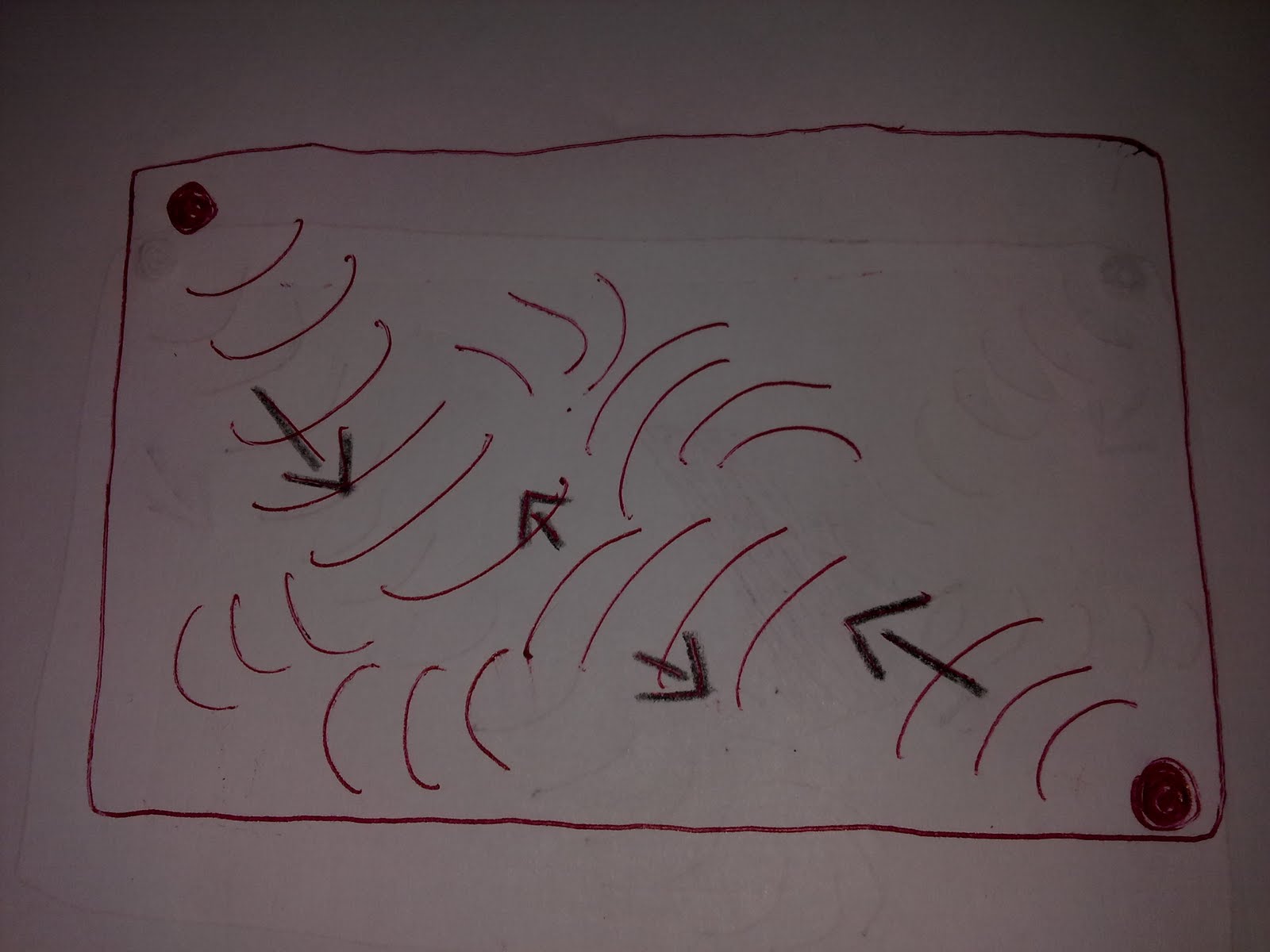
Using two barriers on the side of the tub (in a closed manner), and started creating a wave from another edge, we figured out that waves can’t go in the space between the two barriers, waves can only go around it. In another case, if we create a wave inside the barriers but leave a small opening, one part of the waves will go back, and another will pass through a small opening and start spreading around it.
Mrs. M gave us an example about the marine full of boats being closed in an area. When waves are being disturbed, they can’t go in the marine because it is closed- so the boats are safe.
Picture 5:

Picture 6:

What happens when waves hit a surface?
This was another interesting experiment which I thought was simple and obvious that when waves hit a surface, they travel back, I thought it would be like that in the beginning, however, different kinds of balls travel in different ways. For example, if I hit a type of ball (metallic marble) toward a wall, it stays there because it was too heavy to go back. Comparing a metallic marble with a golf ball, there was a big difference. A golf ball immediately goes back when its’ hit. In my opinion, it depends on how hard you hit a ball. If you hit it hard, then the disturbance of a wave goes back really fast. If you hit the ball lightly, it stays next to the wall. My partner and I decided to hit each ball in a uniform speed way, and most of them didn’t travel back, however a smaller number of them traveled back.
As you can see, when a ball or in our case wave hits a surface, it travels back by the same angle in which it hits it.

In conclusion, we were given the assignment to connect these discovery activities with the section we had to read. The section talks a lot about what we did in class, this means that it was easy for me to connect it to the discovery activities.
In the first discovery activity, where I had to answer: How do waves interact with each other with no barriers, one barrier and two barriers? Having one starting wave begin from an edge, and another from a totally different side. When they meet in the middle they will continue their movement in the same direction but with greater force going up and down. This is called a positive interference, or a constructive interference, and it is occurring because the amplitude of our waves are adding to each other and are becoming bigger.
With one or two barriers, the waves will certainly reflect from the barrier in the angle which is equal to the angle of incidence. This is occurring because of a reflection, also, when we have two barriers with a small opening between them (picture 6) we saw that some of the waves were reflected. But also some parts of it passed through the opening and started spreading through the water, this is called a diffraction.
In the second activity, we had to conclude: What happens when waves hit a surface?
When a wave hits a surface by some angle (called an incidence angle) it goes back, in a changing direction. This other angle is called a reflection angle. These two angles are always equal. The surface where the balls were hit is called a reflection surface.
Firstly, we took a tub and filled it halfway through with water and placed it on the table. We used hard clay as the barrier and our fingers for creating a wave.
When we tested how they interact with each other with no barriers, we found out that the waves continue going to their path even though they meet in the middle. They don’t go back and they don’t even go to the side- they continue their movement, however with just another strength- they will become stronger than they were before meeting each other.
Picture 1:
Picture 2:

After this, we put a barrier in the tub filled it with water, and tried to see what happens when waves meet in the middle. When the waves bumped into the barrier they have changed their directions and continued their movement in a new direction. I thought this was normal, because waves can’t go on the barrier or go IN the barrier.
Picture 3:

Picture 4:

Using two barriers on the side of the tub (in a closed manner), and started creating a wave from another edge, we figured out that waves can’t go in the space between the two barriers, waves can only go around it. In another case, if we create a wave inside the barriers but leave a small opening, one part of the waves will go back, and another will pass through a small opening and start spreading around it.
Mrs. M gave us an example about the marine full of boats being closed in an area. When waves are being disturbed, they can’t go in the marine because it is closed- so the boats are safe.
Picture 5:

Picture 6:

What happens when waves hit a surface?
This was another interesting experiment which I thought was simple and obvious that when waves hit a surface, they travel back, I thought it would be like that in the beginning, however, different kinds of balls travel in different ways. For example, if I hit a type of ball (metallic marble) toward a wall, it stays there because it was too heavy to go back. Comparing a metallic marble with a golf ball, there was a big difference. A golf ball immediately goes back when its’ hit. In my opinion, it depends on how hard you hit a ball. If you hit it hard, then the disturbance of a wave goes back really fast. If you hit the ball lightly, it stays next to the wall. My partner and I decided to hit each ball in a uniform speed way, and most of them didn’t travel back, however a smaller number of them traveled back.
As you can see, when a ball or in our case wave hits a surface, it travels back by the same angle in which it hits it.

In conclusion, we were given the assignment to connect these discovery activities with the section we had to read. The section talks a lot about what we did in class, this means that it was easy for me to connect it to the discovery activities.
In the first discovery activity, where I had to answer: How do waves interact with each other with no barriers, one barrier and two barriers? Having one starting wave begin from an edge, and another from a totally different side. When they meet in the middle they will continue their movement in the same direction but with greater force going up and down. This is called a positive interference, or a constructive interference, and it is occurring because the amplitude of our waves are adding to each other and are becoming bigger.
With one or two barriers, the waves will certainly reflect from the barrier in the angle which is equal to the angle of incidence. This is occurring because of a reflection, also, when we have two barriers with a small opening between them (picture 6) we saw that some of the waves were reflected. But also some parts of it passed through the opening and started spreading through the water, this is called a diffraction.
In the second activity, we had to conclude: What happens when waves hit a surface?
When a wave hits a surface by some angle (called an incidence angle) it goes back, in a changing direction. This other angle is called a reflection angle. These two angles are always equal. The surface where the balls were hit is called a reflection surface.
Saturday, 11 December 2010
FoodINC Reflection

1. After watching Food Inc, what are your impressions of how science of food industry, technology of food industry, and society are interrelated?
I think that food industry, its’ technology and society are connected as the following:
First come a lot of hungry consumers which don’t have enough time to make and eat healthy, not so good looking food. -Is it going to be so tasty without all those chemicals that will be added by the food industry??? No!
Then comes the food industry, which gives the animal, for instance a cow, the fat food to make it better and tastier for us. In the first place, the saddest thing to me, the death of the animal, but certainly it starts off with a circle of an endless production, which should be faster, cheaper, and with a lot additives and chemicals… that’s the time when factories start making the product or packaging for the animal meat to be put in. We, the consumers buy that fat, tasty looking animal to eat at home. We gain the animals fats because we have eaten their meat, so we full-fill our fats, right?
Thirdly, there is one more problem: we also gain all those chemicals from animal meat, and we are not aware of all the consequences on our health while we enjoy in eating the genetically tastiest food ever!
In my opinion, science and technology are described to have a negative impact both on society and the environment. Factories have fewer workers involved because the machines do everything by themselves; however they also can create a huge amount of carbon dioxide and other pollutants which harm the environment. But factories are built to full-fill the needs of the hungry, fast rising human population and so that’s why they are necessary to exist but their technologies are sometimes bad for consumers, because we can intake things that are genetically modified which is not healthy because who know what kind of chemicals they include. Take a hamburger from McDonalds. It is not healthy, doesn’t have any nutrients, and is genetically modified so it is not real at all but it looks and tastes really great!
Consumer choices are not often very smart, but we should really be aware of what we are taking inside of our bodies because our healthy choices will affect our own survival. My mother was retelling a movie to me which is created by a man who had eaten only McDonalds for a month, and at the end of that month, he was much heavier and fatter, exhausted and with a lot of disease that can just a person have who is for example chronically sick. (That is the reason why she doesn’t allow me to go to McDonalds.) So, the point is that we should be very careful when buying and eating something, however, marketing, I admit, is a miracle! We care mostly about taste, and less about health; we, as consumers look at how, or if the food package is nicely decorated, and attractive to us. Also, we look at TV commercials which are also suited in the technology group. But, if we stop buying products, they will not be out in the market anymore because it is a waste of the producers’ time and money to make it. So we should try to raise our own awareness of what we want to eat, and that will direct industry to make healthier products.
Humans have mainly caused problems on the Earth, because they are on the top of food chain, the most intelligent mammals, but the ones that don’t use the Earth just to survive, more to enjoy and obstruct. We caused a lot of disturbance using much more spaces and resources than we really need, also in not recycling, polluting waters, airs, causing global warming etc. we kill mammals and animals to get our food, we cut down trees to get materials such as paper, cardboard and so on. We have done a VARIETY of things to our Earth, and the only way we can change this is by caring, and respecting the environment around us. For instance, we can buy food cans, we can recycle the things that are recyclable, we don’t need to pollute the waters by throwing poisonous trash in there and harming the air by causing climate change with gases coming out of our roof, we have to respect everything around us, because everything around us is ideally our environment and our society. We can help.
5. A few ideas that popped up in conversation throughout the movie were:When do we say "no" to more high tech devices and go back to what caused the problem in the first place? Why are we only into the "HOW" things work and not the "WHY" things don't? What did this farmer mean?
Human health and survival depend on a lot of things. First of all, space and nutrients! They both should be healthy, but, unfortunately, they are not, because everything is getting faster, fatter, bigger, cheaper and less healthy for sure. So the more fats from an animal we gain, the worse it is for us. I would say that technology makes some kind of fake food for us, and it can ruin our health. This also goes to animals. Animals that eat that kind of food are poisoned. Then when we eat the animal, we get poisoned too. So it is a problem anyhow!
8. What economic costs, environmental costs, ethical costs, health costs, and cultural costs did you observe while watching the film?
Everything costs, but the human health most-for example if u are sick, you can’t go to work, you can’t earn money, and you have to pay insurance, medicaments etc. So you waste a lot of money by getting healthier, instead of just keeping your good food choice. The ethical cost can be seen by the unfair choices that are offered by factory owners-buying cheap and tasty, no matter if it’s not healthy. Environmental costs are also obvious, spreading diseases, pollution, occupying spaces etc.
9. Finally, state your final thoughts about this film and any changes you see happening in the food industry in the future or even your own eating habits.
I think that this movie stated the right facts, and everything was very well said. I agree with most of the things, and I learned, well not learned, but figured out why my mom was so against eating my favorite McDonalds meal-now I have much more understanding and facts that I can tell her to support her.
The questions that the farmer has asked are to me very suspicious. In my opinion, people think that they cannot help, and that they cannot do anything to make our environment a better place, because they think that others don’t care, so why waste their time. But they are wrong, every little piece they waste is trouble for the WHOLE Earth. That is a big problem, and that really affects the Earth. The other possible reason is because it can be expensive for them so they don’t want to waste time and money on that. Anyways, back to what I was talking about, humans think that they cannot help, so they make up things that are already possible for them to do, just talk about how things work, and leave out the why because they don’t want to waste time learning more .
Natural farming is much better and causes non-use of technology. The difference between those two things is that natural farming is when farmers use their own hands to pick up food and vegetables, it involves less industry, less chemicals, but also less resources obtained, ex. less food, or meat. In opposite, the industrial farming is when people use technology to do the work for them, it includes big land spaces, machines and chemicals, but all these things should be very controlled, for me, it looks more as “allegedly”. Natural farming is better because it includes clean and not genetically modified, but it cannot give enough food for all people on the Earth, that’s why industrial farming is also necessary!
7. If technology and industry have improved so much that we are getting faster, fatter, bigger, and cheaper, how are science and technology held responsible for improving or ruining human health and survival?Human health and survival depend on a lot of things. First of all, space and nutrients! They both should be healthy, but, unfortunately, they are not, because everything is getting faster, fatter, bigger, cheaper and less healthy for sure. So the more fats from an animal we gain, the worse it is for us. I would say that technology makes some kind of fake food for us, and it can ruin our health. This also goes to animals. Animals that eat that kind of food are poisoned. Then when we eat the animal, we get poisoned too. So it is a problem anyhow!
8. What economic costs, environmental costs, ethical costs, health costs, and cultural costs did you observe while watching the film?
Everything costs, but the human health most-for example if u are sick, you can’t go to work, you can’t earn money, and you have to pay insurance, medicaments etc. So you waste a lot of money by getting healthier, instead of just keeping your good food choice. The ethical cost can be seen by the unfair choices that are offered by factory owners-buying cheap and tasty, no matter if it’s not healthy. Environmental costs are also obvious, spreading diseases, pollution, occupying spaces etc.
9. Finally, state your final thoughts about this film and any changes you see happening in the food industry in the future or even your own eating habits.
I think that this movie stated the right facts, and everything was very well said. I agree with most of the things, and I learned, well not learned, but figured out why my mom was so against eating my favorite McDonalds meal-now I have much more understanding and facts that I can tell her to support her.
Subscribe to:
Posts (Atom)